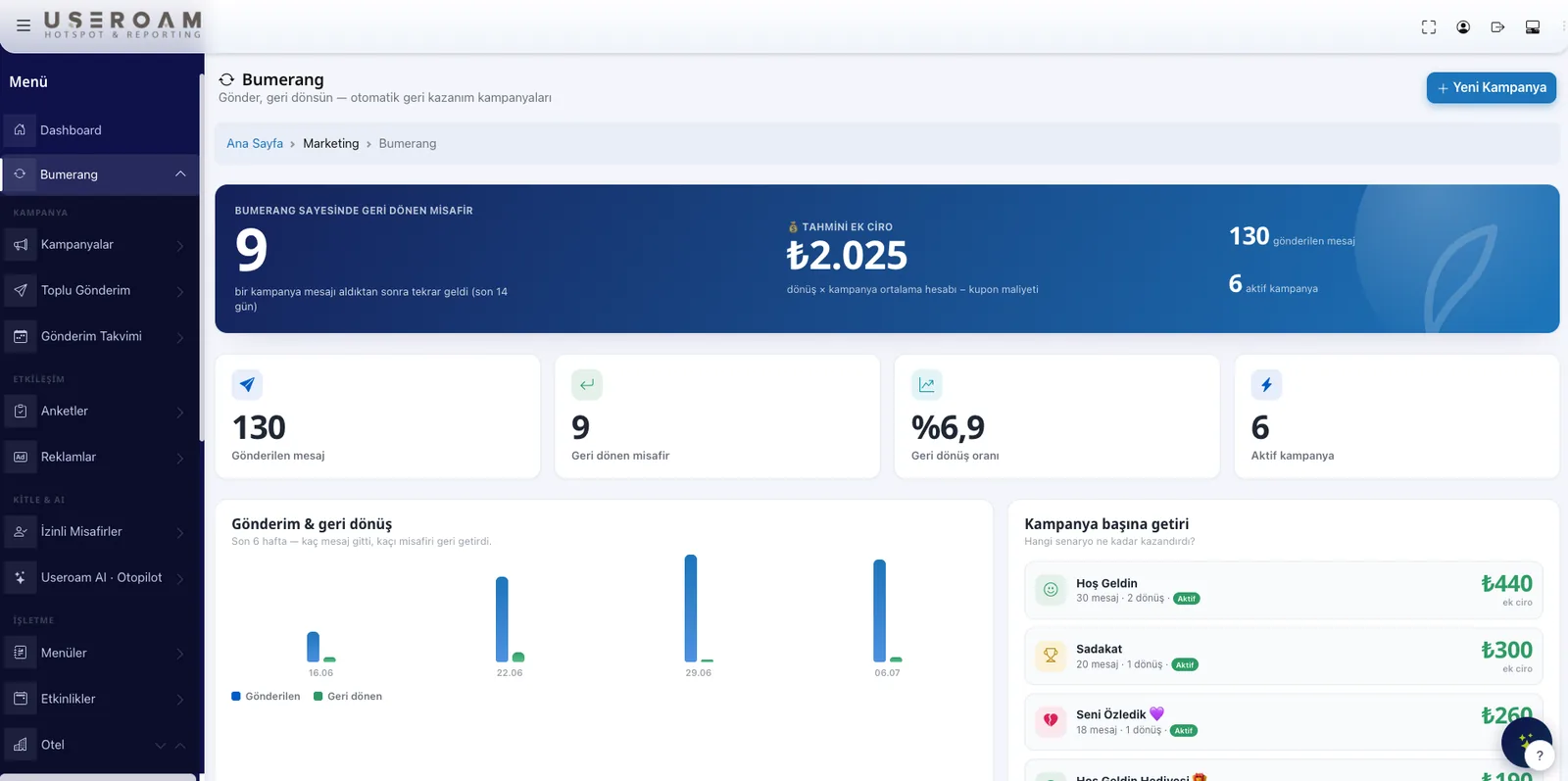
WiFi marketing is the practice of turning the permission-based data collected from visitors who connect to your guest WiFi into repeat visits and revenue — through campaigns, surveys and loyalty scenarios. Giving guests internet access is only the starting point; the real value lies in converting that guest into a returning customer. In this guide we cover what WiFi marketing is, how it works and how to run it with Useroam Bumerang.
What is WiFi marketing, in short?
WiFi marketing is the practice of turning guest WiFi from a cost into a measurable marketing channel. The mechanism is simple: guests identify themselves at the captive portal to get online, and where they give explicit consent, that identity becomes a contactable, permission-based profile. From there the venue can run automated campaigns — a welcome message after the first visit, a we-miss-you message after a period of absence, a loyalty offer on the nth visit — over WhatsApp or SMS, and measure coupons, clicks and actual returning visits against them. What separates WiFi marketing from generic email marketing is attribution: the venue can tell whether a message brought someone physically back through the door. Consent is the boundary: access logging and marketing contact are two separate things, and only guests who opt in explicitly may be messaged. In practice the whole loop — portal, consent record, segment, campaign and result — runs from one dashboard, on top of the network the venue already has.
Looking for a platform rather than a definition? Useroam is a WiFi marketing platform that runs the whole loop — captive portal, guest data, campaigns and reporting — on the network you already have. This guide explains the method behind it.
How does WiFi marketing work?
When a guest connects to your network, the welcome screen (the captive portal) is where they grant you permission to stay in touch. That consented contact data flows into a single dashboard, where automated campaigns are triggered, surveys measure satisfaction and reports show returns in concrete numbers. Instead of guessing what your marketing budget delivers, you measure it.
What WiFi marketing does for your business
- Win-back: Bring one-time visitors back with automated "We Miss You" scenarios.
- Permission-based messaging: SMS and WhatsApp sends run on explicit guest consent, in line with privacy regulations.
- Measurable results: Track exactly how many guests came back, right from the dashboard.
- One dashboard: Campaign, survey and menu data live together instead of scattering across separate tools.
The building blocks of WiFi marketing
- Campaigns: Automated win-back sends over WhatsApp and SMS.
- Surveys: Measure satisfaction and resolve negative feedback internally before it goes public.
- QR Menu: Turn every menu view into product-preference data.
- Hotel In-House: Digital request and service management for hotel guests.
Is free WiFi marketing, or is a paid tier needed?
Free WiFi marketing is the normal case, not a lesser version of it: the guest pays nothing for the connection, and the price they pay is a verified phone number and an explicit consent tick. That is the whole exchange. Where a venue also sells a paid speed upgrade from the portal, the marketing loop does not change — the guest still identifies once, and the speed package simply becomes another thing the same profile can be offered later. What free WiFi marketing is not is anonymous WiFi. An open network with no login screen produces no profile, no consent record and nothing to measure, so there is no marketing in it at all.
What does a guest WiFi marketing system need to include?
Judged by what actually has to be in one place for the loop to close, a guest WiFi marketing system needs five parts:
- A captive portal that verifies identity rather than just showing a terms page — an SMS one-time code, WhatsApp, a room number matched against the hotel PMS, or a time-limited voucher.
- A consent record kept separately from the access log, because permission to message someone and the legal record of who was online are two different obligations.
- A profile that survives the session, so the second visit is recognised as a second visit and not a new stranger.
- A sending channel the guest actually reads — in practice WhatsApp and SMS rather than email, since the portal collected a phone number.
- Reporting that closes the loop, tying a send back to a return visit instead of stopping at delivery counts.
A tool that covers only the first part is a captive portal, not a marketing system. Useroam's own answer to this list is Bumerang, the module suite that carries the campaigns, surveys and reporting on top of the portal.
Segmented WiFi marketing: why one message to everyone fails
Sending the same offer to every guest wastes the two things that matter most — the guest's attention and your sending budget. Segmentation fixes that by grouping profiles on behaviour rather than on guesswork. The common model is RFM: how recently someone visited, how frequently they visit, and what that relationship is worth. In practice this produces a handful of groups a venue can actually act on — regulars worth rewarding, guests who used to come often and are drifting away, and first-timers who have not yet been given a reason to return. Each group gets a different message, and each message is measured on its own. The profiles themselves are unified in Guest 360, so a person recognised at the portal, in a survey and in a campaign is one record rather than three.
WiFi marketing automation: setting it up once
Automation is what makes the loop survive a busy week. Rather than composing a send by hand, the venue defines a trigger once — a welcome shortly after the first connection, a win-back after a defined period of silence, an offer on the nth visit — and the platform sends it whenever a guest meets the condition. Autopilot takes this a step further by proposing the campaign itself from the guest data already collected, leaving the venue to approve rather than to design. The practical effect is that WiFi marketing keeps running on the weeks nobody has time for it, which is usually when it matters.
Cloud WiFi marketing, and what it means for the network
Useroam is cloud software. There is no appliance to rack and no server to maintain on site; the platform sits on top of the firewall or controller the venue already runs — MikroTik, FortiGate, Sophos, Palo Alto, Zyxel and Ruijie among others. For a chain this matters more than it sounds: a new location is a configuration rather than a deployment, and every branch reports into the same panel instead of into its own island.
Tracking repeat visits: the number that settles the argument
The reason WiFi marketing can be argued about at all is that most marketing cannot prove a physical return. This can. Because the same identity is recognised at the portal on every visit, the platform counts unique guests separately from total sessions, and the ratio between them is the repeat-visit rate. Run a win-back campaign against a segment and the rate moves — or it does not, which is equally useful information. Guest WiFi analytics reports this alongside day-and-hour density, so a venue can see not just whether guests came back but when.
White label WiFi marketing for agencies and integrators
Resellers rarely want to sell someone else's brand. The captive portal, the QR menu and the hotel guest portal all carry the end customer's branding rather than Useroam's, and the panel is multi-tenant, so an integrator manages many venues from one login while each venue sees only its own. This is the model behind the partner programme, and it is the reason white label WiFi marketing tends to be an integrator question rather than a venue question.
Which businesses is it for?
Cafes, restaurants, hotels, shopping malls, retail — every business that hosts guests benefits from WiFi marketing. Setup is a one-time job, and a single cafe owner manages it from the same dashboard as a five-star hotel. For deeper strategies, see customer win-back campaigns and customer segmentation with WiFi data.
Frequently Asked Questions
Is WiFi marketing privacy-compliant?
Yes. All contact data is collected with explicit consent and managed in line with privacy regulations — and where local rules require access logging, that runs automatically too.
Does it work with my existing guest WiFi setup?
Yes. Useroam Bumerang modules integrate with your existing guest WiFi infrastructure.
Ready to put this into practice? See how the Useroam WiFi marketing platform works, or explore the Bumerang modules that run the campaigns.